The corn is tasseling, but I don't expect good ears. The system is extremely nutrient deficient right now, since there is so little fish biomass. The system is designed to handle around 800 lbs of fish, but there's only around 10-15 lb of fish in there right now. So since the fish part is running at about 2% of capacity, and since I'm not adding fertilizer, the plant part is extremely nutrient starved. Since it takes lots and lots of nutrients to make good ears of corn, the ears probably won't develop into anything worth eating.
If you're wondering why I'm not using fertilizer, here's why: the cheap stuff is toxic to aquaponics systems, and an adequate supply of the safe stuff (Maxicrop, aka Seasol) is tremendously expensive for a system as large as mine. I've considered dumping a bunch of phosphoric acid (which would yield phosphates as it decomposed) and nitric acid (which would yield nitrates), but it would still cost a sizable amount for the quantities I'd need. Therefore, I'm choosing to just wait until the fish can do their job. The fish are brooding now, so if there's a good hatch and good survival, the tank should be up to capacity in 4-6 months.
Pioneering in aquaponics and high tunnel growing; specializing in bananas, rare figs, and pure blue tilapia.
Thursday, September 15, 2011
Wednesday, September 14, 2011
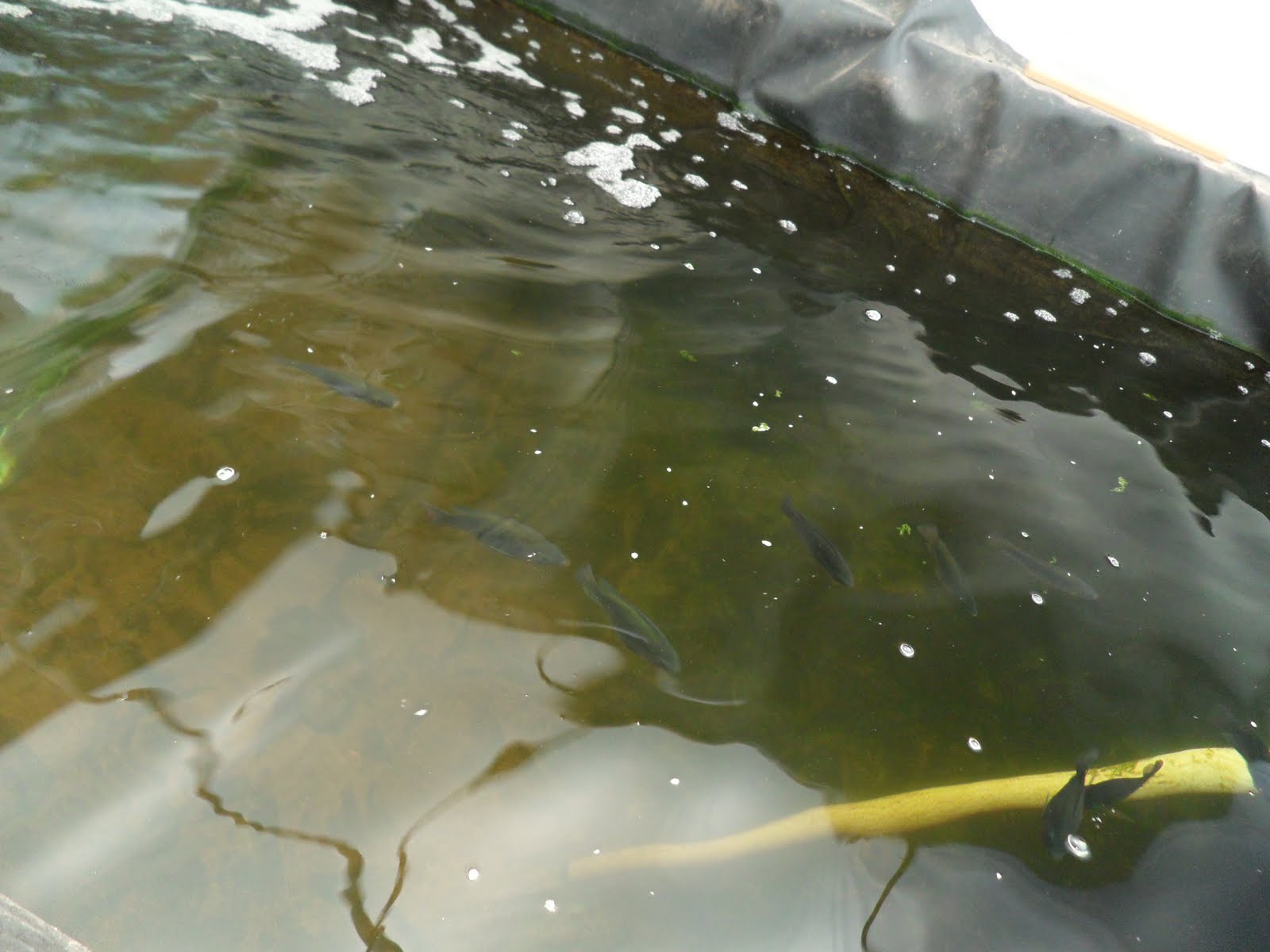
Tilapia are brooding
The blue-colored tilapia you see here are females with mouths full of eggs/fry. The mums should spit out the fry in a couple of weeks.
If I had panned around, you'd have seen some algae building up on the pvc and walls (you can actually see a little bit of green on the pvc in the vid). The only reason there's any algae to see is because the females have stopped feeding while they brood. Before they started brooding, the tilapia kept the pvc bone-white and the water sparkling (they LOVE algae, consuming it both by filtering the water and by nibbling on underwater surfaces on which it grows).
The males are significantly longer and are white with blue dorsal fins. This was surprising to me, since males of most animal species are usually the showy/colorful sex and the females are usually duller and less colored. Regardless, these white males constantly defend their nests (clean swept patches on the bottom) and try to attract romance (darting up to the school of females and 'flashing' in an attempt to get a lady to follow). You can see one of them flash near the top of the screen at the 20-second mark in the video below, and another at the 34-second mark.
Most of these tilapia are probably 7-9" long right now. They were only 1" long when they arrived about 3 months ago (June 2nd).
If I had panned around, you'd have seen some algae building up on the pvc and walls (you can actually see a little bit of green on the pvc in the vid). The only reason there's any algae to see is because the females have stopped feeding while they brood. Before they started brooding, the tilapia kept the pvc bone-white and the water sparkling (they LOVE algae, consuming it both by filtering the water and by nibbling on underwater surfaces on which it grows).
The males are significantly longer and are white with blue dorsal fins. This was surprising to me, since males of most animal species are usually the showy/colorful sex and the females are usually duller and less colored. Regardless, these white males constantly defend their nests (clean swept patches on the bottom) and try to attract romance (darting up to the school of females and 'flashing' in an attempt to get a lady to follow). You can see one of them flash near the top of the screen at the 20-second mark in the video below, and another at the 34-second mark.
Most of these tilapia are probably 7-9" long right now. They were only 1" long when they arrived about 3 months ago (June 2nd).
Tuesday, August 23, 2011
Aquaponics Corn update
The Honey & Cream sweet corn in the high tunnel aquaponics system is getting bigger, as you can see here:
I had wondered whether we'd see a decrease in plant health and robustness along the flow of the bed as the water lost oxygen along its route. I think we're seeing a slight hint of that effect: the corn towards the beginning is bigger and yellower, while the corn towards the end is smaller and greener. I think what's happening is this: due to decreasing oxygen levels, the corn towards the beginning is growing faster than the corn toward the end; and since the grow bed is new and lacking in sufficient nutrient buildup, the faster-growing corn is yellower since, due to nutrient deficiencies, its rate of growth is outstripping the rate at which it can manufacture chlorophyll.
It's interesting to note that the system is so nutrient starved (due to having so few fish in it so far) that the aquaponics corn is lagging behind the outdoor sample of the same variety that was planted at the same time:
The corn I grew in my small aquaponics system last year grew about 50% faster than the corn I grew alongside it in the dirt garden, and I have little doubt that the current larger system will produce similar results once it gets better established.
I had wondered whether we'd see a decrease in plant health and robustness along the flow of the bed as the water lost oxygen along its route. I think we're seeing a slight hint of that effect: the corn towards the beginning is bigger and yellower, while the corn towards the end is smaller and greener. I think what's happening is this: due to decreasing oxygen levels, the corn towards the beginning is growing faster than the corn toward the end; and since the grow bed is new and lacking in sufficient nutrient buildup, the faster-growing corn is yellower since, due to nutrient deficiencies, its rate of growth is outstripping the rate at which it can manufacture chlorophyll.
It's interesting to note that the system is so nutrient starved (due to having so few fish in it so far) that the aquaponics corn is lagging behind the outdoor sample of the same variety that was planted at the same time:
The corn I grew in my small aquaponics system last year grew about 50% faster than the corn I grew alongside it in the dirt garden, and I have little doubt that the current larger system will produce similar results once it gets better established.
Monday, August 15, 2011
Composting Worms for Aquaponics
Most aquaponics systems benefit significantly from being stocked with composting worms. When the worms eat the fish waste and vegetative matter in your grow bed, their digestive process unlocks a tremendous amount of nutrients that would not otherwise have become available for the plants. This results in significantly faster, lusher, and more productive plant growth. On top of this, the activities of the worms help to keep the growbed flowing smoothly by reducing the risk of clogging.
I stocked my high tunnel aquaponics system with red wrigglers (eisenia fetida), which are especially well suited for media-based aquaponics grow beds (gravel, clay hydroton, etc) due to their small size and big appetites. I don't raise and sell composting worms, but you can order them online from sources like this:
Retail Price: $36.50
You Save: $10.00
from: CompostMania
Retail Price: $59.50
You Save: $10.00
from: CompostMania
Retail Price: $109.00
You Save: $10.00
from: CompostMania
Sunday, August 7, 2011
Greenhouses and High Tunnels
High tunnels are an inexpensive type of greenhouse that are well-suited for aquaponics. I use a high tunnel to protect my aquaponics system from the elements and to allow year-round growth, even when outdoor temperatures are below freezing.
If you're interested in a greenhouse or high tunnel, I'd suggest getting a kit from Growers Supply. I was referred to them by the manager of a local nursery and have been pleased with them.
Click on the picture below to check out their extensive selection of greenhouses, high tunnels, and supplies. Happy hunting!
If you're interested in a greenhouse or high tunnel, I'd suggest getting a kit from Growers Supply. I was referred to them by the manager of a local nursery and have been pleased with them.
Click on the picture below to check out their extensive selection of greenhouses, high tunnels, and supplies. Happy hunting!
Thursday, August 4, 2011
Aquaponic Corn
The corn is coming up:
Some wily critters tore into a sack of wheat berries, so I put the spillage in a bucket with some water. Hopefully the wheat will soften up enough (and be tasty enough) that the tilapia will eat it.
Compost pile:
Getting a bit portly:
Here's the only vegetation I left in the greenhouse when I planted the corn. The greener stuff in the bottom left is basil, lightly cooked. The sprawling tomato plant actually originated as a limb that broke off of one of the old monster plants. I stuck the limb in the ground to see if it would take root, and it did. It has flowered quite a bit, but with the temps getting so hot (108F outside, and hotter than that in the greenhouse), it's having trouble setting any fruit.
Some wily critters tore into a sack of wheat berries, so I put the spillage in a bucket with some water. Hopefully the wheat will soften up enough (and be tasty enough) that the tilapia will eat it.
Compost pile:
Getting a bit portly:
Here's the only vegetation I left in the greenhouse when I planted the corn. The greener stuff in the bottom left is basil, lightly cooked. The sprawling tomato plant actually originated as a limb that broke off of one of the old monster plants. I stuck the limb in the ground to see if it would take root, and it did. It has flowered quite a bit, but with the temps getting so hot (108F outside, and hotter than that in the greenhouse), it's having trouble setting any fruit.
Monday, August 1, 2011
Testing My Aquaponics System with Sweet Corn
I've just cleaned out the high tunnel and planted the entire grow bed with a sweet corn variety called "Merit." I don't expect the corn to do very well for a number of reasons: extreme high temps during the days, high humidity, and low (but exponentially growing) levels of fish poo to name a few. That said, I'll still be able to learn some valuable info by seeing how the corn grows relative to itself; that is, whether there is uniform growth throughout the grow bed.
Hopefully we'll see uniform growth, but disparities would not be unexpected. Oxygen levels could be a culprit of such disparities: since I only oxygenate the water while it is in the fish tank, that means that the water steadily loses oxygen as it passes through the grow bed. If plants don't get enough oxygen to their roots, their growth will be stunted (or they'll outright die). If oxygen levels drop below desired levels along the water's path through the grow bed, it will be visually obvious: the plants will be continually smaller along the path.
Nutrient levels also diminish along the way as water passes through the grow bed, so another possible cause of any variations in the growth pattern may be attributable to a lack of nutrients (i.e. insufficient fish waste).
If I don't see any systemic variations, then that means the nutrient and oxygen levels are remaining sufficiently high throughout the water's path through the grow bed. If the plants get smaller along the water's path, though, then the system is suffering from insufficient oxygen, insufficient nutrients, or both.
Here's the mighty corn patch in its current form:
And here are some gratuitous pics from the fish half of the aquaponics system:
The outside garden is full of sprouting corn. The section in the first pic is just double rows of corn; the section in the 2nd pic features watermelon and cantaloupe plants in between the double rows of corn. I'm hoping the combo strategy will be successful since watermelon plants send their roots much deeper than corn plants (thereby allowing the watermelon and corn to pull their water and nutrients from different strata). We'll see.
Hopefully we'll see uniform growth, but disparities would not be unexpected. Oxygen levels could be a culprit of such disparities: since I only oxygenate the water while it is in the fish tank, that means that the water steadily loses oxygen as it passes through the grow bed. If plants don't get enough oxygen to their roots, their growth will be stunted (or they'll outright die). If oxygen levels drop below desired levels along the water's path through the grow bed, it will be visually obvious: the plants will be continually smaller along the path.
Nutrient levels also diminish along the way as water passes through the grow bed, so another possible cause of any variations in the growth pattern may be attributable to a lack of nutrients (i.e. insufficient fish waste).
If I don't see any systemic variations, then that means the nutrient and oxygen levels are remaining sufficiently high throughout the water's path through the grow bed. If the plants get smaller along the water's path, though, then the system is suffering from insufficient oxygen, insufficient nutrients, or both.
Here's the mighty corn patch in its current form:
And here are some gratuitous pics from the fish half of the aquaponics system:
The outside garden is full of sprouting corn. The section in the first pic is just double rows of corn; the section in the 2nd pic features watermelon and cantaloupe plants in between the double rows of corn. I'm hoping the combo strategy will be successful since watermelon plants send their roots much deeper than corn plants (thereby allowing the watermelon and corn to pull their water and nutrients from different strata). We'll see.
Subscribe to:
Posts (Atom)